A short guide for parents
Your child wants to play Dungeons & Dragons
D&D is a game of shared storytelling. A few friends sit around a table with pencils, paper and dice and invent an adventure together. No screens and no winners or losers. The whole group succeeds or fails as a team.
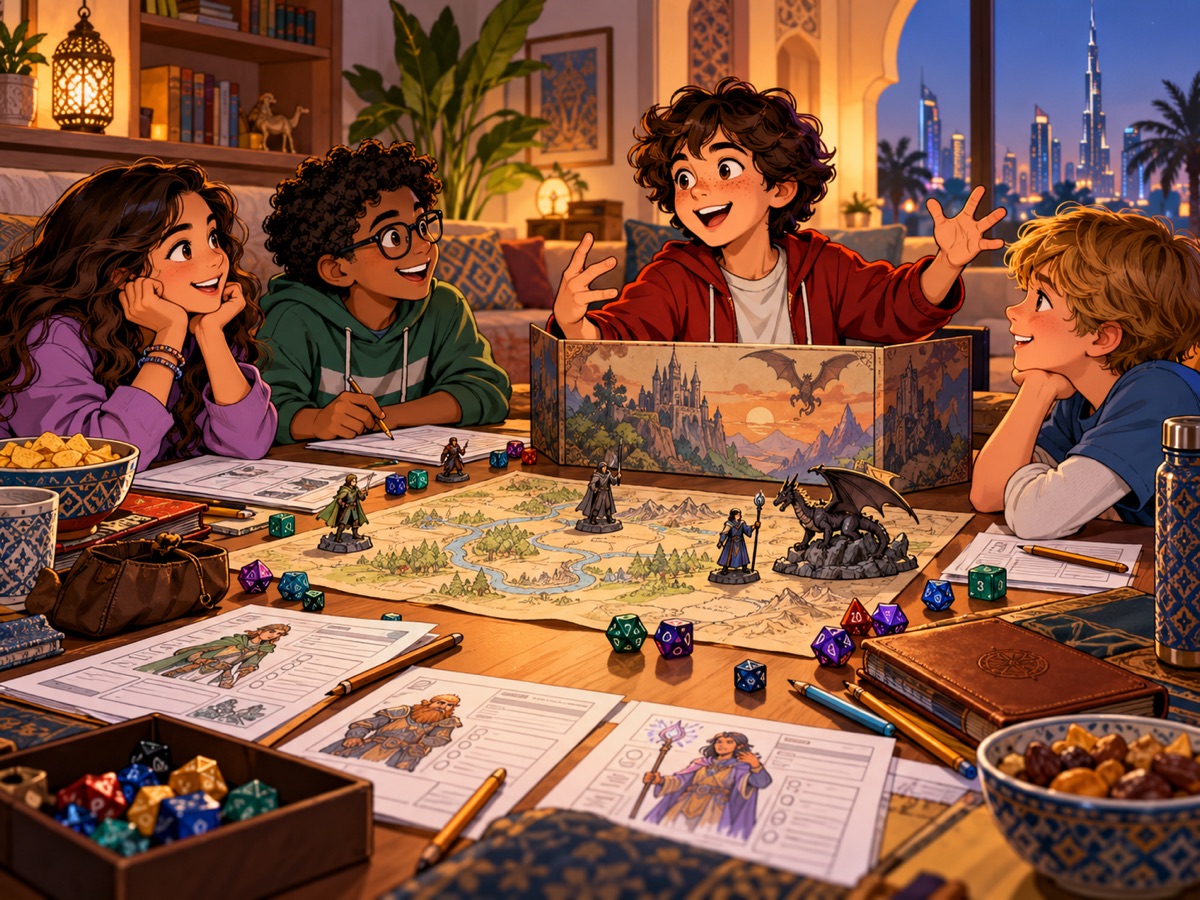
What it actually looks like
One person, the Dungeon Master, describes the scene. Each player says what their character does. When the outcome is uncertain, a die decides. Here is a typical thirty seconds at the table:
The rope bridge over the canyon creaks. Half the planks look rotten. On the far side, a goat is stuck on a ledge and bleating.
My ranger tests each plank with her staff before stepping on it. Can I do that?
Good idea. Roll a d20 and add your Wisdom bonus.
You find the three bad planks and step over them. You're across. Now, about that goat…
The d20 is a twenty-sided die. Adding a small bonus is quick mental arithmetic, done dozens of times a session without anyone calling it maths.
Who does what
The Dungeon Master
Narrator and referee. Prepares the story, voices the other characters and keeps the game fair. In a kids' group this is usually an adult.
The players
Usually 3 to 6. Each plays one character with a name, a personality and a sheet that lists what they are good at.
The adventure
Explore a ruin, solve a riddle, negotiate with a grumpy troll, rescue someone. A session lasts 2–3 hours, and a story can continue over several meetings.
What children get from it
- Real friends, face to face
A regular table of the same kids, week after week, talking and laughing together. For a child who has just moved to a new country, this is often the fastest way to build a circle.
- Teamwork
Nobody wins alone. The group has to listen, share ideas and agree on a plan before the clock runs out.
- Speaking up
Every player has to describe what they do, out loud, to the group. Shy children find this easier through a character.
- Reading and numbers
Character sheets, rules and clues all have to be read. Dice rolls and bonuses are constant small sums.
- Creative problem solving
Most problems have no single right answer. A clever plan or a kind word often works better than a fight.
- Empathy
Playing someone with a different background, temper or fears means thinking about how other people see the world.
Research on this is young, but encouraging. In 2023 the Seattle education research group Foundry10 and the nonprofit Game to Grow studied 10–14-year-olds playing D&D weekly and reported growth in communication, collaboration and perspective-taking. Similar small programmes at universities and hospitals in the US and Canada use the game to help teenagers practise social skills.
Questions parents usually ask
Isn't it about magic and demons?
D&D is fantasy in the tradition of The Lord of the Rings and Harry Potter: knights, elves, dragons and wizards. Magic in the game is a set of rules, like a superpower in a comic. Nobody performs rituals or worships anything.
The "dangerous game" reputation comes from a moral panic in 1980s America. Researchers tested those claims for more than a decade and found no link to crime, suicide or occult practice. Today the game is mainstream: the 2023 film, the TV series Stranger Things, school and library clubs around the world.
The Dungeon Master chooses what goes into the story. In a children's game we keep to adventure, exploration and puzzles, and we respect every family's faith and values. Tell us if there is anything you would like left out.
Is it violent?
There are fights with monsters, as in any adventure story, but they happen in words and dice rolls. There are no images and nothing graphic. Many problems are solved by talking, sneaking or thinking. For a children's table the tone is closer to a family film than to a video game.
Dice — is it gambling?
No. Nobody bets anything and there is no money or prize. A die only decides whether a character's action in the story succeeds, the way a spinner works in a board game.
Isn't this just more screen time?
The opposite. Our sessions are played in person at a table, with paper character sheets, pencils and dice. Phones stay in bags.
How much time does it take?
A session is about 2–3 hours, at an agreed time, like a chess club or a music lesson. Many children start reading fantasy books or drawing their characters between sessions, which most parents count as a plus.
What age is it for?
Most children are ready around 10–12, once they can take turns, cope with a setback and read a character sheet. Teenagers are the game's core audience. What matters more than age is a good group and a Dungeon Master who keeps the table friendly.
Does it cost anything?
To try, nothing. The basic rules are free online from the publisher, and the Dungeon Master brings dice and pre-made characters. If your child loves it, a set of dice costs about the same as a paperback.
Who supervises?
An adult runs every game. Parents are welcome to sit in, watch, or take a character and play. Many parents who try it end up joining.
How you can help
- Say yes to a first session and see how your child comes home.
- Ask about their character. Who are they, what happened, what will they do next time? Kids love to tell it.
- Come and watch for half an hour, or play. It is one of the few games parents and teenagers enjoy as equals.
If you want to read more
- Benefits of Dungeons and Dragons for kidsTabletop Gaming magazine, 2024. A parent describes what the game gave her son.
- Is D&D safe for kids?Wargamer, 2023. A psychiatrist reviews the research on the 1980s fears.
- Can D&D help youth build social skills?GeekWire, 2023. On the Foundry10 and Game to Grow study.
- Is D&D right for my kid?Nerdarchy, 2018. An educator on readiness, shy children and siblings.
- Inside the magical world of Abu Dhabi's D&D groupThe National, 2022. Players right here in the UAE.
- The free D&D rulesD&D Beyond, the publisher's official site.